

RelyComply’s white paper, Bridging the Compliance Gap, opens with a problem every African bank should be taking seriously. Financial crime no longer looks like cash in a briefcase. It moves through the same digital channels banks use to process salaries, settle RTGS instructions, and clear bulk payment files.
The infrastructure most banks have in place was not built for that reality.
AML fines scaled from $800 million to $3 billion globally in the past two years. Legacy AML systems carry false positive rates exceeding 90%.
The compliance gap is widening, financial products are moving faster than the systems designed to monitor them. The institutions most exposed are often the ones with the oldest infrastructure.
The pressure is real, and it is landing here first
South Africa, Kenya, Nigeria, Ghana, Tanzania, Uganda. These are not peripheral markets, they are where African financial services are growing fastest, and where payment volumes are climbing most steeply.
Everyone seems to be moving in the same direction: faster settlement, more complete records, shorter reporting windows.
Banks with modern payment infrastructure absorb new mandates as configuration changes. Banks without it run development projects.
That distinction is where compliance cost either stays manageable or compounds.
The layer everyone skips past
Most compliance conversations start with AML programs, KYC processes, and regulatory reporting. Necessary conversations, but they skip past the layer where compliance data is generated first: the payment switch.
Every salary run, every RTGS instruction, every EFT batch passes through the payment processing layer before it reaches its destination.That layer creates the transaction record, handles encryption, verifies balances, and either routes exceptions automatically or leaves them to a person with a spreadsheet.
The payment layer is the first and most complete record of what happened, when, to whom, and for how much.
Most banks evaluate payment infrastructure on throughput and uptime. They evaluate compliance separately, against entirely different criteria. That separation is where the exposure lives.
What compliance-ready actually means at infrastructure level
It is not a compliance module bolted on top of a payment switch, it’s the way the switch is built.
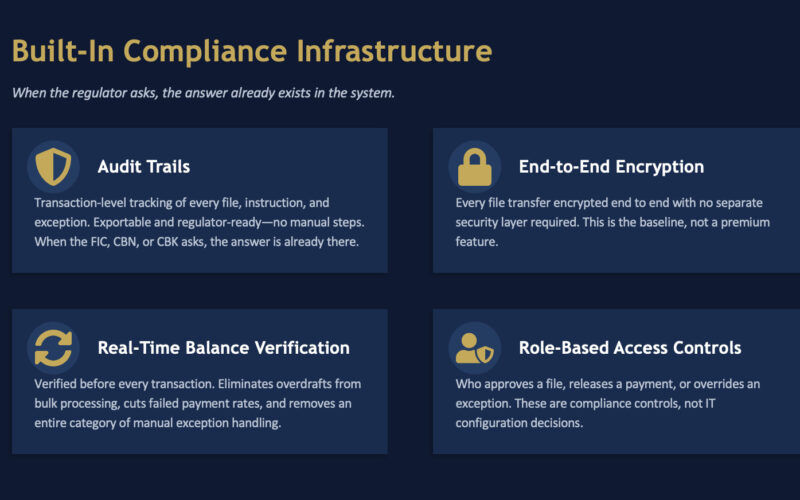
Four things define it:
- Audit trails at transaction level: every file, every instruction, every exception. Exportable and regulator-ready without a manual step. When the FIC, CBN, or CBK asks a question, the answer already exists in the system.
- Encryption on every file transfer: end to end, no separate security layer. This is the baseline, not a premium feature.
- Real-time balance verification: Before every transaction. This eliminates overdrafts from bulk processing, cuts failed payment rates, and removes an entire category of manual exception handling from the compliance team’s plate.
- Role-based access controls: who approves a file, who releases a payment, who overrides an exception. These are compliance controls, not IT configuration decisions.
None of these are exotic, they’re the foundations of a payment infrastructure a compliance function can rely on. The problem is that many banks deliver some and not others, and compensate for the gaps with manual processes and additional headcount.
The real cost of the gap
Compliance is only as strong as the data it runs on, and the data starts at the point of processing.
The banks managing this most efficiently have one thing in common. They separated their payment layer from their core banking system cleanly, connected via pre-built integrations, and absorbed mandate changes at the platform level.
Closing the gap
The compliance gap closes through infrastructure built to make compliance operationally sustainable.
Banks that treat payment infrastructure and compliance infrastructure as the same problem will carry less regulatory risk, respond faster to mandate changes, and free their compliance teams to focus on analysis rather than data recovery.
How we can help
Xpertek’s SFI eVolve sits alongside your existing core banking system. No rip-and-replace. Pre-built connectors for T24, Flexcube, and Finacle. Months to go live, not 18–36.
R32bn+ processed monthly. 21 countries. 36+ installations. Built for African banking since 1989.
If this raises questions about how your current payment layer maps to your compliance requirements, we are worth 30 minutes.
Book a call with Anneke Weber info@xpertek.co.za | +27 11 519 3000 | xpertek.co.za/xpertek-sfi-evolve

